
The First Motorized Boat Trip Through Grand Canyon
The Story of the Esmeralda II Expedition
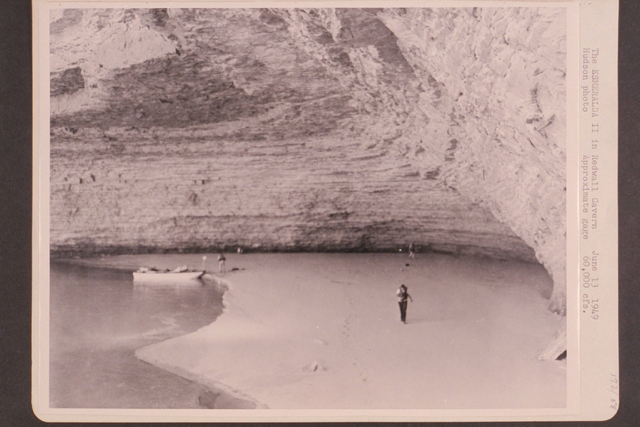
The Esmeralda II, piloted by Ed Hudson with navigator Otis “Dock” Marston and crew members Ed Hudson Jr., Bestor Robinson, and Wilson Taylor, made the first motorized run through the Grand Canyon from June 12–17, 1949. The timing of this trip is striking: John Wesley Powell had completed his first expedition nearly 80 years earlier, and nearly 80 years have now passed since the Esmeralda II journey. Prior to this historic run, only about 100 people had been documented as traveling the length of the Colorado River through the Grand Canyon.
The Esmeralda II was designed and built by Ed Hudson, who invested approximately 700 hours of labor over 11 months. The boat measured 19¼ feet in length and was constructed of plywood. It was named after the nearly 95-foot steam-wheeler Esmeralda, which had traveled upriver on the Colorado to Callville in 1866. The boat was first tested in Morro Bay, California, in May 1948. Hudson designed the craft specifically to run upstream on the Colorado River, with enough power to push against a 25-mph current on a 5-degree slope. The total construction cost was $2,000 in 1948.
Power came from a 125-horsepower Graymarine Phantom Six engine. As Gene Segerblom wrote in an April 1950 Popular Mechanics article, “The gas mileage was extremely poor, averaging about one and a half to two gallons per mile.” Fuel supply quickly became one of the expedition’s greatest challenges. To address this, “the sides of the cockpits were lined with shelves to hold five-gallon cans of gasoline.”
The trip’s only serious mishap occurred during a mule-train resupply. One of the gasoline cans leaked onto a mule, and the fuel on its skin caused intense pain. The mule began bucking and panicking, which in turn caused the rest of the mule train to erupt into chaos. In the commotion, many of the gasoline cans were punctured and rendered unusable. As a result, all of the fuel containers had to be replaced with gas cans flown in from Phoenix.
The crew pushed off into the Colorado River at a flow of 55,000 cubic feet per second. Ed Hudson Jr. and Bestor Robinson photographed the boat running Badger Creek and Soap Creek Rapids. The engine briefly cut out in Badger Creek but restarted. Marston later wrote that “the big boulder at 18.5 Mile was only six feet out of the water and created a frenzied run on its right. We camped on the right bank a half-mile below, where Edward nursed his feet.”
On June 13, the second day of the expedition, the crew experienced repeated engine failures. Near Mile 35, Marston recorded that “we landed under oars. Water had entered the hatches and wet the distributor.” After drying it out, the engine restarted and the journey continued. Later, after “half-drowning the engine in a water rumpus at Mile 60 Rapid,” the crew fitted a rubber sack over the engine and covered the hatch with a tarpaulin.
That night they camped near the base of the Tanner Trail, flying a flag to signal to those on the rim that they were safe. Grand Canyon National Park Superintendent Harold Bryant had previously issued a stern warning: “Our budget doesn’t allow for these rescues. Our parks belong to the whole United States, so we shouldn’t be asked to take time out of our staff for just five Americans.”
On June 14, the river continued to rise, reaching 71,000 cfs at Phantom Ranch. Hance Rapid tested the boat severely, taking on large amounts of water. Marston noted that “the escape from the debacle clearly proved that Hudson had built a boat that could withstand the most brutal water violence.” At high water, Sockdolager Rapid was “cooled to a riffle.” The crew waited at Phantom Ranch for replacement fuel cans and spent their third night camped at the boat beach.
Day four, June 15, was largely uneventful as the group passed Horn Creek, Granite, Hermit, pre-flood Crystal, and the Gems. Waltenberg Rapid was washed out, and Bedrock Rapid was completely covered. The crew stopped at Tapeats Creek to repair the propeller and fish in the clear water.
On June 16, Bestor Robinson—who served on the Department of the Interior’s Advisory Committee on Conservation—“examined the area for a possible resort,” Marston recorded, “should the Bridge Canyon Dam back water to this point.” Farther downstream, Marston noted that “Deer Creek Falls was plunging directly into the river.”
At the head of Lava Falls, the crew met John and Laura Riffey. John Riffey was the custodian of Grand Canyon National Monument and the long-time ranger at Toroweep. After the Esmeralda II successfully navigated Lava Falls, the Riffeys hiked back to the rim and radioed word of the safe passage to the South Rim.
The expedition was resupplied with fuel by a group of 37 people led by Bishop Chester Bundy and his brother Pat at the foot of the Whitmore Trail. Marston observed that Mile 205 “was brawling into a cliff on river right and could be classified as major.” That night, the group camped at Mile 207.
On the morning of June 17, Ed Hudson announced that others could take the helm after Mile 217. This marked the completion of his guidance of a motorized craft through the entire Grand Canyon—having previously uprun the boat to that point and then run it back down to Lake Mead the previous summer. Hudson explained his technique to Marston: positioning the boat carefully and “closing his eyes when the rollers hit.” Marston later wrote, “This cleared in my mind some of the spasmodic struggles that had been such a puzzle.”
The Esmeralda II reached Pierce Ferry at 1:10 p.m. Bill Belknap and Cliff Segerblom greeted the crew in a Dodge Power Wagon “well supplied with throat coolers,” Marston noted.
More About the The First Motorized Boat Trip Through Grand Canyon