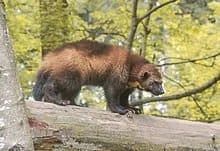
Wolverines have a reputation for being very mean solitary animals but a lot of stories we hear are not true. A recent study by Fish and Games researchers tracked 18 wolverines between September 2007 and March 2014 to find out just what they are up to. Here are some interesting facts they found.
Wolverines will interact with each other and wrestle and play as long as food is abundant.
Their eyesight and hearing are not very good but they have an incredible sense of smell.
They have a high mortality rate for their young. Two to four kits born in the spring usually become one to two by fall. Females have a litter about every other year starting at three years of age.
Wolverines can cover 30 miles a night and have incredible stamina.
They have an amazing ability to travel through rough mountainous terrain.
They are mostly scavengers but also hunt snowshoe hares, voles, ground squirrels and marmots.
They have a very thick warm coat.
Wolverines also have very strong jaws. This is important for crushing bones and eating frozen meat.
They have strong claws for climbing, digging and defense.
Wolverines have a large home territory. Females cover 115 to 230 square miles and males cover 270 to 380 square miles.
It is amazing to see these creatures in their habitat from the raft or camp, so join us on an Alsek or Tatshenshini river trip for some spectacular wildlife viewing opportunities.
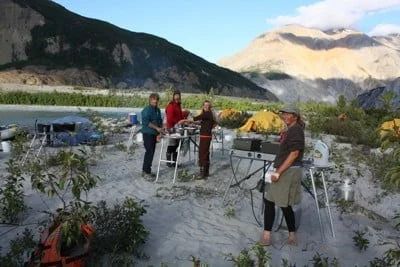
Cooking Fish Tacos at the Wolverine Camp. John Toner, Martha Clark, Mindy Mackay, and Bruce Quayle.
In recent years one of our best wolverine viewing opportunities happened along the Alsek River near the Fisher Glacier. Our camp was set up along the clear blue waters of the outlet of the lake below the glacier. The camp was full of white sand and the camping opportunities were abundant. We had just ran Lava North Rapid and were being treated to some of Martha Clark’s delicious Halibut Fish Tacos. As the evening progressed Mindy Mackay noticed a wolverine running up a scree slope behind our camp. From our viewpoint it was clear that the wolverine would not be able to rim out using this path. The wolverine was incredibly fit and climbed the 200 yards of 70 degree vertical scree, realized it could not make it up the last 20 foot cliff, turned around, and ran back to the bottom. Then it moved over 50 yards and tried again…finishing the climb with the same fate. Finally on the third attempt it found a scree slope that enabled it to rim out into the pine trees above camp. In all we had seen the wolverine for about 5 minutes. It was one of the best wildlife viewings ever. Although you don’t see a wolverine every trip, it is an incredible wildlife sighting when it happens.